
Exercise Guide
Barbell Front Squat: Do your elbows point toward the floor?
Keep your elbows high the whole time you squat down and stand up.
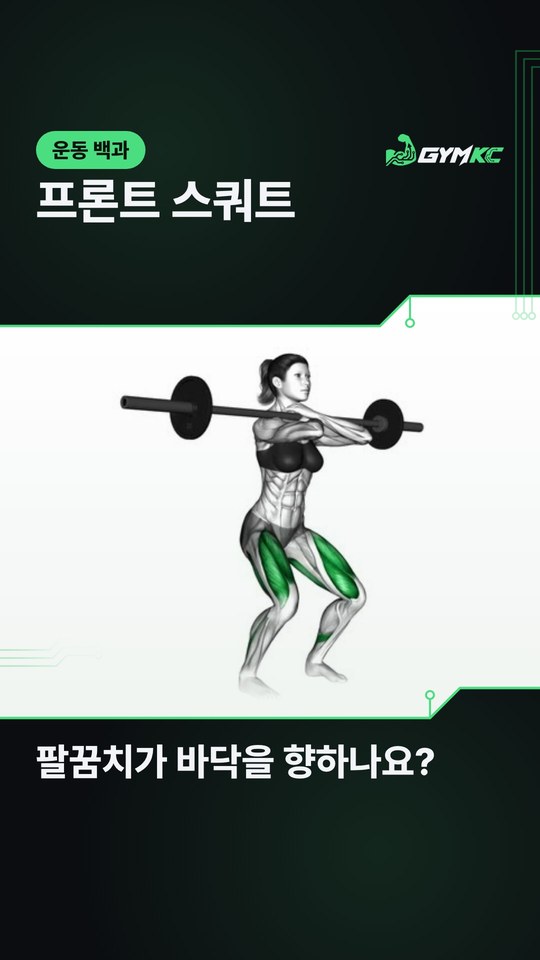
How to fix it
- Rest the bar across the front of your shoulders.
- Bend your hips and knees to squat down.
- Straighten your hips and knees to stand back up in the starting position.
Caution As you squat down and stand up, keep your knees pointing in the same direction as your feet. Do not let them cave inward.
The app sets the weight for your next set
Log a set and GYMKC calculates the weight and reps for your next set.
Last workout40 kg × 7 repsAll sets completed
Next42.5 kgOne weight step up
Example for a beginner, using a routine you set up yourself.
Get GYMKC on the App StoreThe 14-day free trial applies only to Apple accounts subscribing for the first time, and the actual terms appear in the App Store payment sheet.
Where should your hands go?
Sources differ. Some have you choose one of two hand positions. Others present a position where you cross your arms and rest your hands on the bar. Another source says to use the crossed-arm position if mobility problems keep you from getting into the position that supports the bar, or if you have injured your wrists. Either way, keep your elbows high the whole time you squat down and stand up.
See this exercise in detail
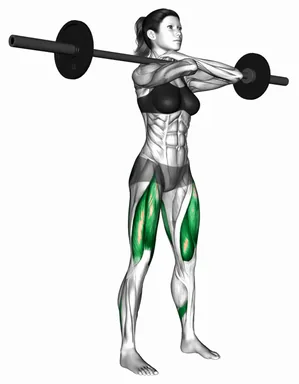
Barbell Front SquatFull form and how-to
More on the same body part
Sources
11 sources
- Western Illinois University, NSCA Lifting Proficiencies · Front Squat
- NSCA, TSAC Module 3.0-3.3 · Back/Front Squat
- NSCA, Basics of Strength and Conditioning
- Bozkurt Ö et al., Frontiers in Physiology (2025)
- McCormick JB et al., International Journal of Sports Physical Therapy (2023)
- Goršič M et al., Sports Biomechanics (2024)
- Bautista D et al., International Journal of Exercise Science (2020)
- ExRx.net, Barbell Front Squat
- CrossFit, Essentials · The Front Squat
- BarBend, Nail the Front Squat for Leg Muscle and Power
- BarBend, Is Your Front Rack Lacking? Try These 5 Fixes (Plus Some Technique Tips)
This article is based on our analysis of public content from evidence-based training experts in Korea and abroad. It is not a substitute for medical advice.