
Exercise Guide
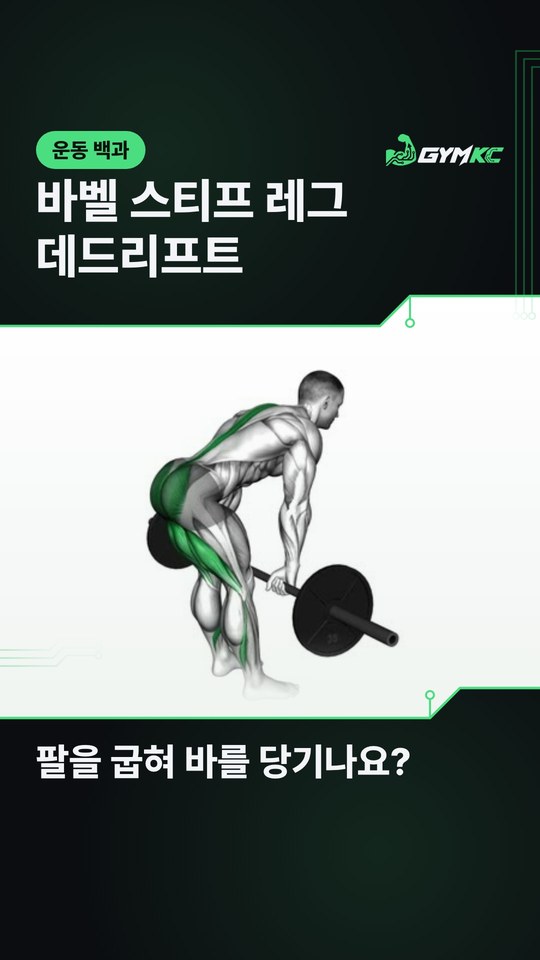
Barbell Stiff Legged Deadlift: Are you bending your arms to pull the bar?
Keep your arms straight as you straighten your hips to stand up. Do not bend your arms to pull the bar.
How to fix it
- Stand upright with your arms straight and the bar in front of your thighs.
- Push your hips back as you slowly lean your torso forward, lowering the bar toward the floor.
- Keep your arms straight, and straighten your hips to return to a standing position.
Caution Do not round your back, and do not use momentum to lean your torso back.
The app sets the weight for your next set
Log a set and GYMKC calculates the weight and reps for your next set.
Last workout50 kg × 10 repsAll sets completed
Next52.5 kgOne weight step up
Example for a beginner, using a routine you set up yourself.
Get GYMKC on the App StoreThe 14-day free trial applies only to Apple accounts subscribing for the first time, and the actual terms appear in the App Store payment sheet.
How much should you bend your knees?
Sources differ slightly. Some suggest keeping your knees slightly bent. One study had participants lower and raise the bar with their knees straight. Either way, keep your arms straight throughout the movement.
See this exercise in detail
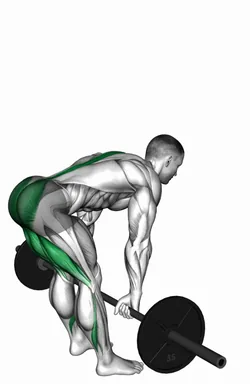
Barbell Stiff Legged DeadliftFull form and how-to
More on the same body part
Sources
9 sources
- Western Illinois University, NSCA Lifting Proficiencies · Stiff-Leg Deadlift
- NSCA, TSAC Module 3.0-3.3 · Deadlift/Stiff-Leg Deadlift
- Holmes CJ, ACSM's Health & Fitness Journal (2020)
- Hegyi A et al., Scandinavian Journal of Medicine & Science in Sports (2018)
- Kawama R et al., Journal of Strength and Conditioning Research (2021)
- Coratella G et al., International Journal of Environmental Research and Public Health (2022)
- ExRx.net, Barbell Stiff Leg Deadlift
- U.S. Army, ATP 7-22.02 Holistic Health and Fitness Drills and Exercises
- NSCA, Personal Training Quarterly · Resistance Training Progressions for the Older Adult: Deadlifts
This article is based on our analysis of public content from evidence-based training experts in Korea and abroad. It is not a substitute for medical advice.