
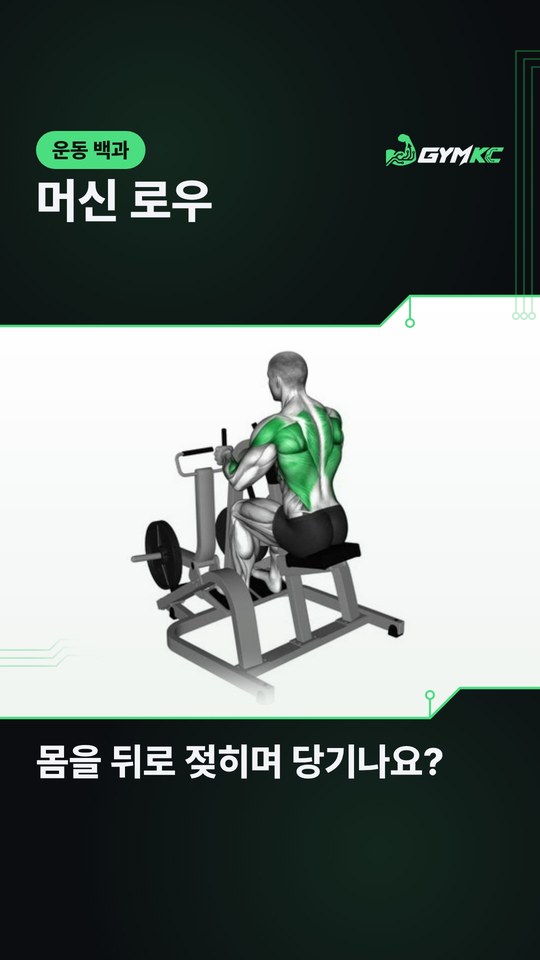
Single-Arm Cable Row: Do you shrug your shoulder as you pull?
Keep your shoulder down instead of shrugging as you move your elbow back and pull the handle toward you.
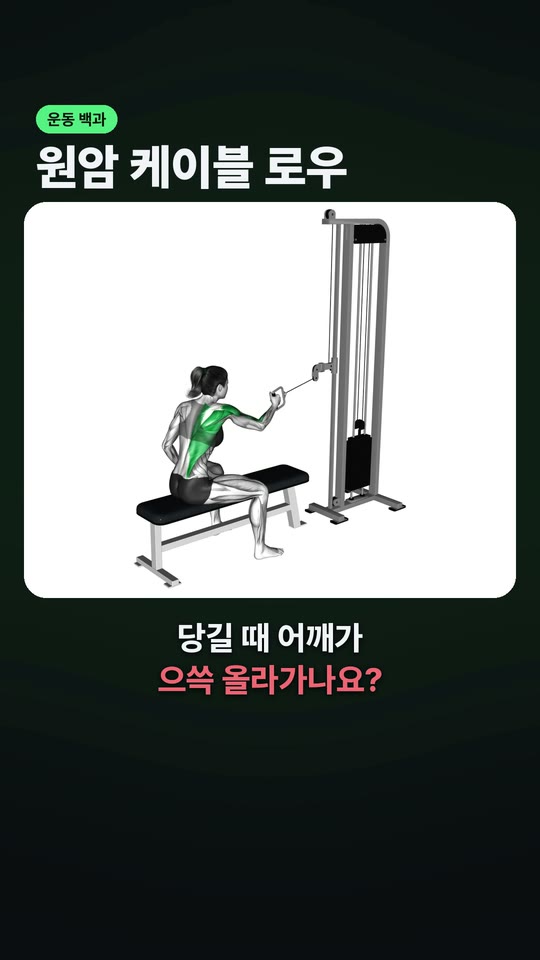
How to fix it
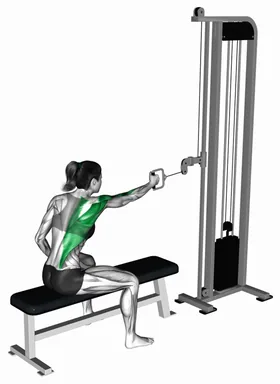
- Sit on the bench and grasp the handle with one hand.
- Keep your shoulder down and away from your ear as you pull.
- Move your elbow back as you pull the handle toward your body.
The app sets the reps for your next set
Log a set and GYMKC calculates the weight and reps for your next set.
Example for a beginner.
Get GYMKC on the App StoreShould you flare your elbow out?
It varies by source. A source lists lifting the elbows up and out during a two-arm seated row as a mistake, with wide-grip rows as an exception. A study on the two-arm seated cable row only reports that upper and middle trapezius and rear shoulder muscle activity is greater as the angle of the arms out to the sides approaches 90 degrees, while maximum force and latissimus dorsi activity are greater as it approaches 0 degrees. Either way, keep your shoulder down as you pull.
See this exercise in detail
More on the same body part
Sources
15 sources
- Rodríguez-Perea Á et al., Journal of Functional Morphology and Kinesiology (2025)
- Saeterbakken A et al., International Journal of Sports Medicine (2015)
- ACE, Exercise Library · Single Arm Row
- FitMetrics, Single Arm Seated Cable Row: form, muscles worked and video
- Macros Inc, Single Arm Seated Cable Row
- Your PT, Seated Cable Row: Form & Scapular Mechanics
- The Workout Mag, Fix Seated Cable Row Form: Scapular Retraction Cues
- NSCA, Basics of Strength and Conditioning
- Western Illinois University, NSCA Lifting Proficiencies · Seated Row
- Padovan R et al., Journal of Functional Morphology and Kinesiology (2025)
- Vasconcelos CMWA et al., International Journal of Strength and Conditioning (2023)
- U.S. Army, ATP 7-22.02 Holistic Health and Fitness Drills and Exercises
- NASM, Exercise Library · Seated Machine Row Close Grip
- Healthline, Seated Row: Muscles Used, Common Mistakes, Modifications
- NSCA, Strength and Conditioning Journal column (Lantz · McNamara, 2003)
This article is based on our analysis of public content from evidence-based training experts in Korea and abroad. It is not a substitute for medical advice.