
Exercise Guide
Bodyweight Half Squat: Does your body drop suddenly as you go down?
Push your hips back and lower yourself slowly at a controlled pace. Do not drop down suddenly.
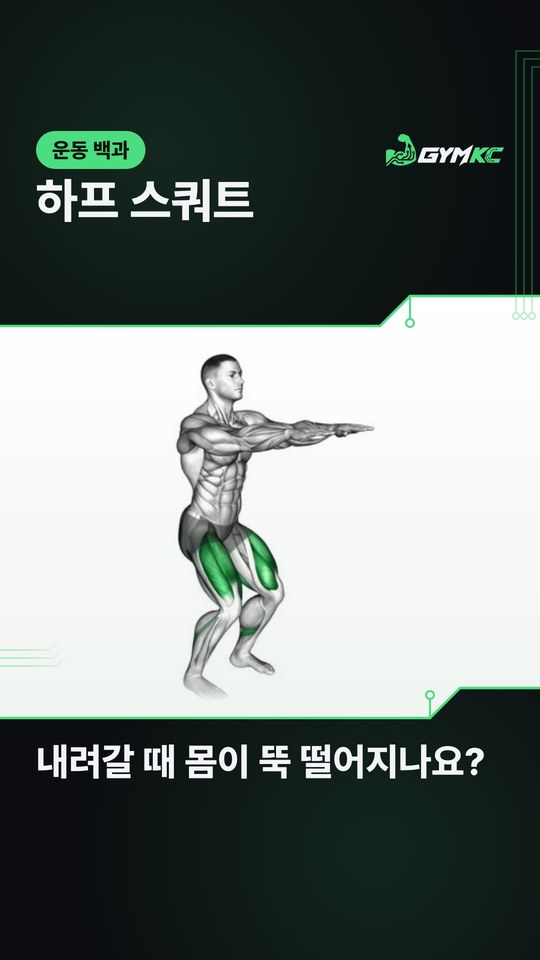
How to fix it
- Stand with both arms extended in front of you.
- Push your hips back as if sitting down in a chair, and bend your hips and knees together as you slowly lower yourself.
- Push the floor away with your feet to stand back up in the starting position.
Caution Do not let your knees cave inward as you squat down and stand up.
The app sets the reps for your next set
(For exercises you added to your routine yourself) For example, if you are a beginner and completed all 3 sets of 12 reps using your bodyweight as planned in your last workout, the app increases your reps to 13. When you log your sets, GYMKC reads your last set and recalculates the reps for your next set.
Get GYMKC on the App StoreThe 14-day free trial applies only to Apple accounts subscribing for the first time, and the actual terms appear in the App Store payment sheet.
How far should you lower yourself?
Sources differ. Some suggest lowering yourself until your knees are bent to 90 degrees. Others suggest lowering your hips about 10 inches. Either way, lower yourself slowly and with control.
See this exercise in detail
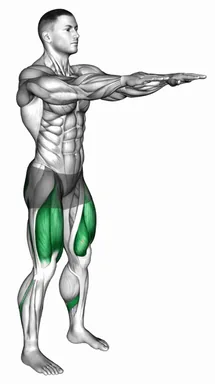
Bodyweight Half SquatExercise info · Related exercises
More on the same body part
Sources
- Myer GD et al., Strength and Conditioning Journal (2014)
- Li X et al., Biology (2021)
- Panero E et al., Journal of Healthcare Engineering (2017)
- NSCA, Basics of Strength and Conditioning
- AAOS, Knee Conditioning Program · Half Squats
- NASM, Exercise Library · Prisoner Squat
- University Hospitals Sussex NHS Foundation Trust, Standing Exercises · Mini Squat
- University College London Hospitals NHS Foundation Trust, Home exercises to improve strength and balance following hospital admission · Squats
- Mayo Clinic, Squat exercise
- ExRx.net, Squat
This article is based on our analysis of public content from evidence-based training experts in Korea and abroad. It is not a substitute for medical advice.