
Stationary Bike: Set the seat height before you ride.
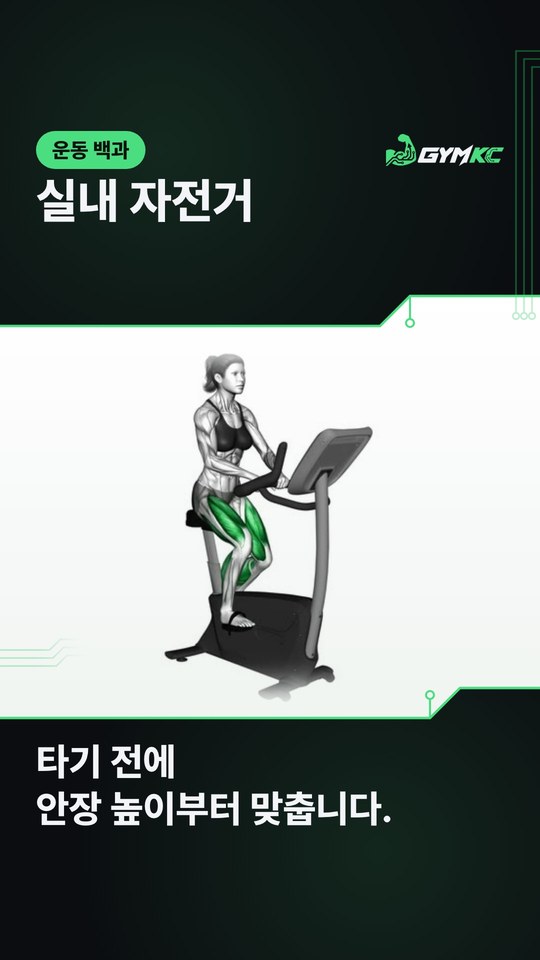
Set the seat height before you ride, so your knee is slightly bent when the pedal is at the bottom.
How to fix it
- Set the seat height first, then adjust the forward and backward position.
- Check that when the pedal is at the bottom, your knee is slightly bent rather than fully straight and locked.
- As you pedal, keep your shoulders down and away from your ears, without hunching or rounding them.
The app sets the time for your next set
(For exercises you added to your routine yourself) For example, if you are a beginner and completed all 20 minutes as planned in your last workout, the app sets your next time to 21 minutes. When you log your sets, GYMKC reads your last set and recalculates the time for your next set.
Get GYMKC on the App StoreHow much should your knee bend?
The angle of knee bend differs between sources. One hospital source says the bend should be very subtle, about 5 to 10 degrees. One paper recommends a knee bend angle of 25 to 35 degrees, measured in a still position. Either way, set it so your knee is slightly bent rather than fully straight and locked when the pedal is at the bottom.
See this exercise in detail
More on the same body part
Sources
- ACSM, Selecting and Effectively Using a Stationary Bicycle
- Human Kinetics, Methods of Group Exercise Instruction · Positioning, alignment, and safety in group cycling classes
- Bini R et al., Sports Medicine (2011)
- Holliday W et al., Sports Medicine and Health Science (2021)
- Priego-Quesada JI et al., Sports Medicine (2024)
- Wadsworth DJS et al., International Journal of Sports Physical Therapy (2019)
- Ferrer-Roca V et al., Journal of Strength and Conditioning Research (2012)
- HSS, How to Set Up an Exercise (or Spin) Bike Properly
- ACE, Fit Facts · Spin It: What You Need to Know About Group Indoor Cycling
- AFAA, Indoor Cycling Form: A Complete Guide
- UPMC, HealthBeat · Learn Proper Indoor Cycling Form
- Harvard Health Publishing, Biking and sex: avoid the vicious cycle
This article is based on our analysis of public content from evidence-based training experts in Korea and abroad. It is not a substitute for medical advice.