
Barbell Lunge: Does your front knee cave inward?
As you lower yourself, bend your front knee in the same direction as the toes of your front foot. Keep it from caving inward.
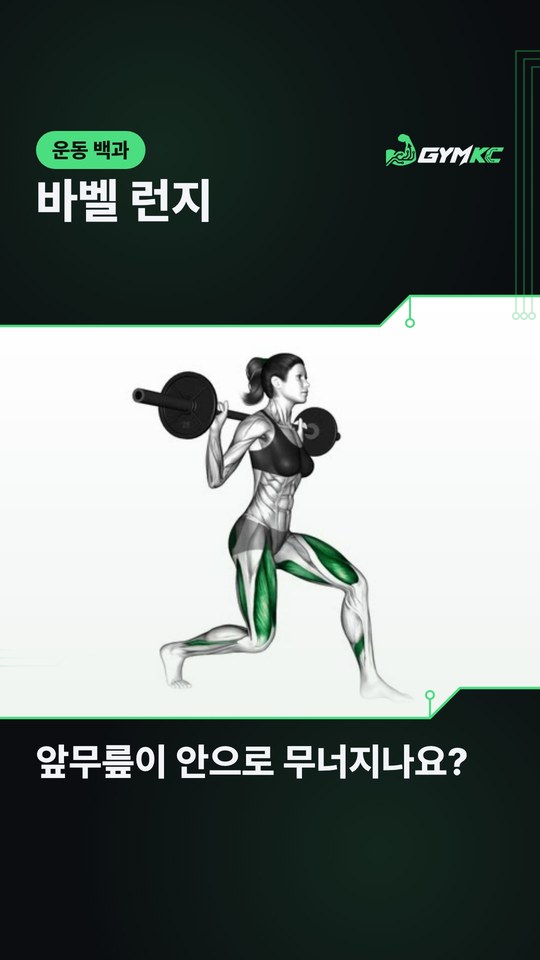
How to fix it
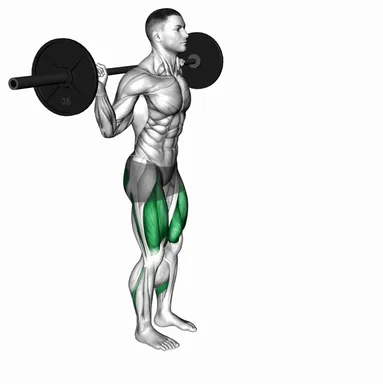
- Rest the bar on your upper back, just below your neck.
- As you lower yourself, bend your front knee in the same direction as the toes of your front foot.
- Push through your front foot to stand back up in the starting position.
The app sets the weight for your next set
(For exercises you added to your routine yourself) For example, if you are a beginner and completed all 3 sets of 10 reps at 30kg as planned in your last workout, the app sets your next weight to 32.5kg. When you log your sets, GYMKC reads your last set and recalculates the weight and reps for your next set.
Get GYMKC on the App StoreHow far should you lower yourself?
Sources use different guidelines. Some suggest lowering yourself until your back knee is 3 to 5cm above the floor. Others suggest lowering yourself until both knees are bent about 90 degrees, if possible. Either way, lower yourself only as far as you comfortably can, and do not let your back knee touch the floor.
See this exercise in detail
More on the same body part
Sources
- Western Illinois University, NSCA Lifting Proficiencies · Forward Lunge
- NSCA, Personal Training Quarterly · The Undervalued Lunge
- Riemann BL et al., Journal of Athletic Training (2012)
- López-de-Celis C et al., Healthcare (2023)
- ExRx.net, Barbell Lunge
- ACE, Exercise Library · Forward Lunge
- Mayo Clinic, Lunge exercise
- Cleveland Clinic, How To Do Lunges: Form, Variations and Muscles Worked
This article is based on our analysis of public content from evidence-based training experts in Korea and abroad. It is not a substitute for medical advice.