
One-Arm Dumbbell Row
How to do it
Starting position
- Place your right knee and right hand on the bench.
- Stand with your left foot planted firmly on the floor.
- Hold the dumbbell in your left hand and let it hang toward the floor.
- Look at the floor in front of the bench.
Movement
- Squeeze your left armpit to lift the dumbbell.
- Let your elbow brush past your side as it comes up.
- Slowly lower while feeling your back contract.
Breathing
Exhale as you pull the dumbbell and inhale as you lower it.
Trainer tips
- Place one hand and one knee on the bench
- Pull your elbows toward your hips
- Pull with your back without rotating your torso
Cautions
- Rounding your back can cause a lumbar injury, so keep your back straight.
- Using momentum strains the joints, so move slowly.
- Twisting the torso to use momentum
- Shoulders shrugging up
If you feel pain during the exercise, stop. If it continues, talk to a professional.
Exercise info
| Primary muscles |  Upper back  Lats |
|---|---|
| Secondary muscles | Rear delts · Biceps · Forearms |
| Equipment |  Dumbbell |
| Movement pattern | Horizontal pull |
| Rep range | 8–12 reps (one side at a time) |
4 similar exercises
Representative exercise: One-Arm Dumbbell Row
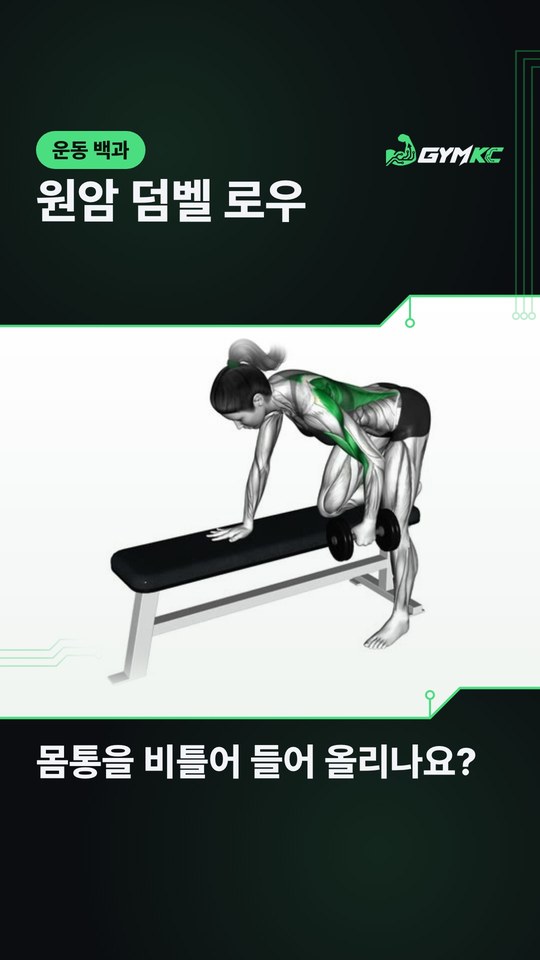 Exercise GuideAre you twisting your torso to lift?Watch the video and see how to fix it
How GYMKC sets the weight for this exercise
For example, if you do 8 reps with 12 kg in each hand and log that you could have done about 2 more, GYMKC estimates your 1RM per hand at about 16.2 kg.
With the dumbbell, each step is 2 kg (5 lb), so the next weight is 14 kg per hand. Within your 8–12 reps target, the sets you log decide whether to add reps first or add weight.
These numbers are an example of how the calculation works. Your actual prescription is recalculated every set from your own records. See how the calculation works
Related exercises
Dumbbell Bent Over RowHarderDumbbell Bent Over Single Arm RowHarderMachine RowSimilar exerciseBand RowSimilar exerciseWeighted Plate Bent-Over RowSimilar exerciseBarbell Bent Over RowSame muscle · different equipment
This information is based on our analysis of public content from evidence-based training experts in Korea and abroad. It is not a substitute for medical advice.
Weights and sets differ from person to person. The GYMKC app uses the sets you log to calculate the weight and reps for your next set.