
Barbell Back Squat
How to do it
Starting position
- Set the rack height slightly below your collarbone
- Grip the barbell wider than shoulder width and place it on your traps
- Set your feet shoulder-width apart and point your toes slightly outward
- Look slightly above eye level and align your posture
Movement
- Keep your back straight, push your hips back, and bend your knees as you slowly lower down
- Lower your body until your thighs are parallel to the floor
- Place your weight across your entire foot and push hard against the floor to stand up
Breathing
Inhale deeply as you go down, and exhale forcefully as you come up
Trainer tips
- Keep your chest up and brace your core
- Drive your knees out in the direction of your toes
- Push the floor away with your whole foot
Cautions
- Heavy weight can strain your lower back, so maintain a neutral spine
- Letting the knees collapse inward
- Rounding the lower back
- Lifting the heels off the floor
If you feel pain during the exercise, stop. If it continues, talk to a professional.
Exercise info
| Primary muscles |  Quads  Glutes |
|---|---|
| Secondary muscles | Adductors · Hamstrings · Lower back · Abs |
| Equipment |  Barbell  Power rack / half rack / squat rack |
| Movement pattern | Squat |
| Rep range | 6–10 reps |
21 similar exercises
Representative exercise: Barbell Back Squat
- Barbell Pin Squat
- Barbell Full Squat
- Barbell Low Bar Squat
- Barbell Olympic Squat
- Barbell Quarter Squat
- Barbell High Bar Squat
- Barbell Squat 2 sec Hold
- Barbell Elevated Heel Squat
- Barbell Full Squat (Back POV)
- Barbell Squat Form Correction (Hips)
- Barbell Squat Form Correction (Knees - End Position)
- Barbell Squat Form Correction (Knees - Middle Position)
- Barbell Wide Squat
- Barbell Pulse Squat
- Barbell Narrow Stance Squat
- Barbell Full Squat (with Rack)
- Barbell Low Bar Squat with Rack
- Landmine Squat with Linebacker Attachment
- Barbell Core Squat
- Barbell Jefferson Squat
- Barbell Pause Full Squat
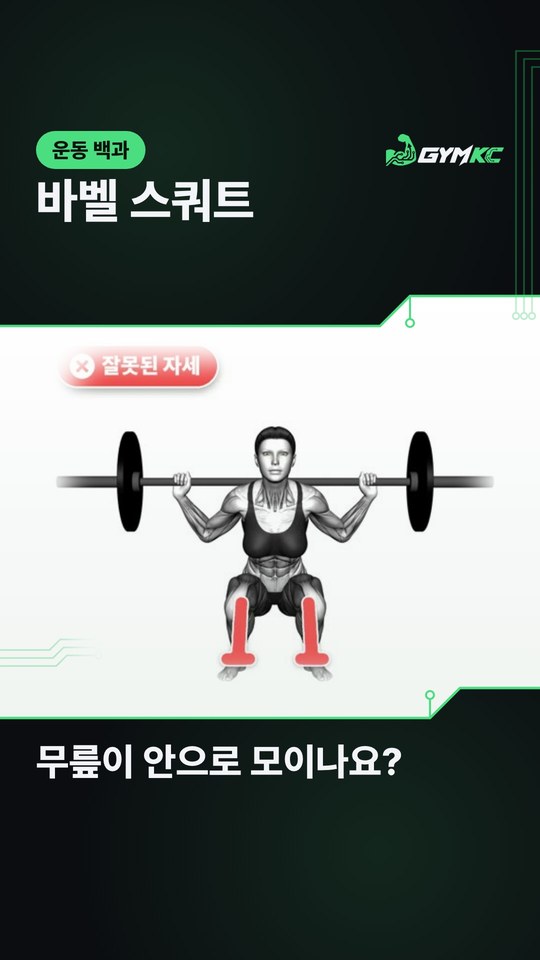 Exercise GuideDo your knees cave inward?Watch the video and see how to fix it
How GYMKC sets the weight for this exercise
For example, if you do 6 reps with 60 kg and log that you could have done about 2 more, GYMKC estimates your 1RM at about 76.3 kg.
With the barbell, each step is 2.5 kg (5 lb), so the next weight is 62.5 kg. Within your 6–10 reps target, the sets you log decide whether to add reps first or add weight.
These numbers are an example of how the calculation works. Your actual prescription is recalculated every set from your own records. See how the calculation works
Related exercises
Goblet SquatEasierLeg PressEasierBarbell Elevated Hack SquatHarderBarbell Snatch BalanceHarderDumbbell Front SquatSimilar exerciseMachine Belt SquatSimilar exerciseSmith SquatSimilar exerciseMachine Squat (Plate Loaded)Same muscle · different equipmentBodyweight SquatSame muscle · different equipment
This information is based on our analysis of public content from evidence-based training experts in Korea and abroad. It is not a substitute for medical advice.
Weights and sets differ from person to person. The GYMKC app uses the sets you log to calculate the weight and reps for your next set.